
Technical guide Reading time: 9 minutes Updated September 28, 2026 GC4I team, structural engineering firm
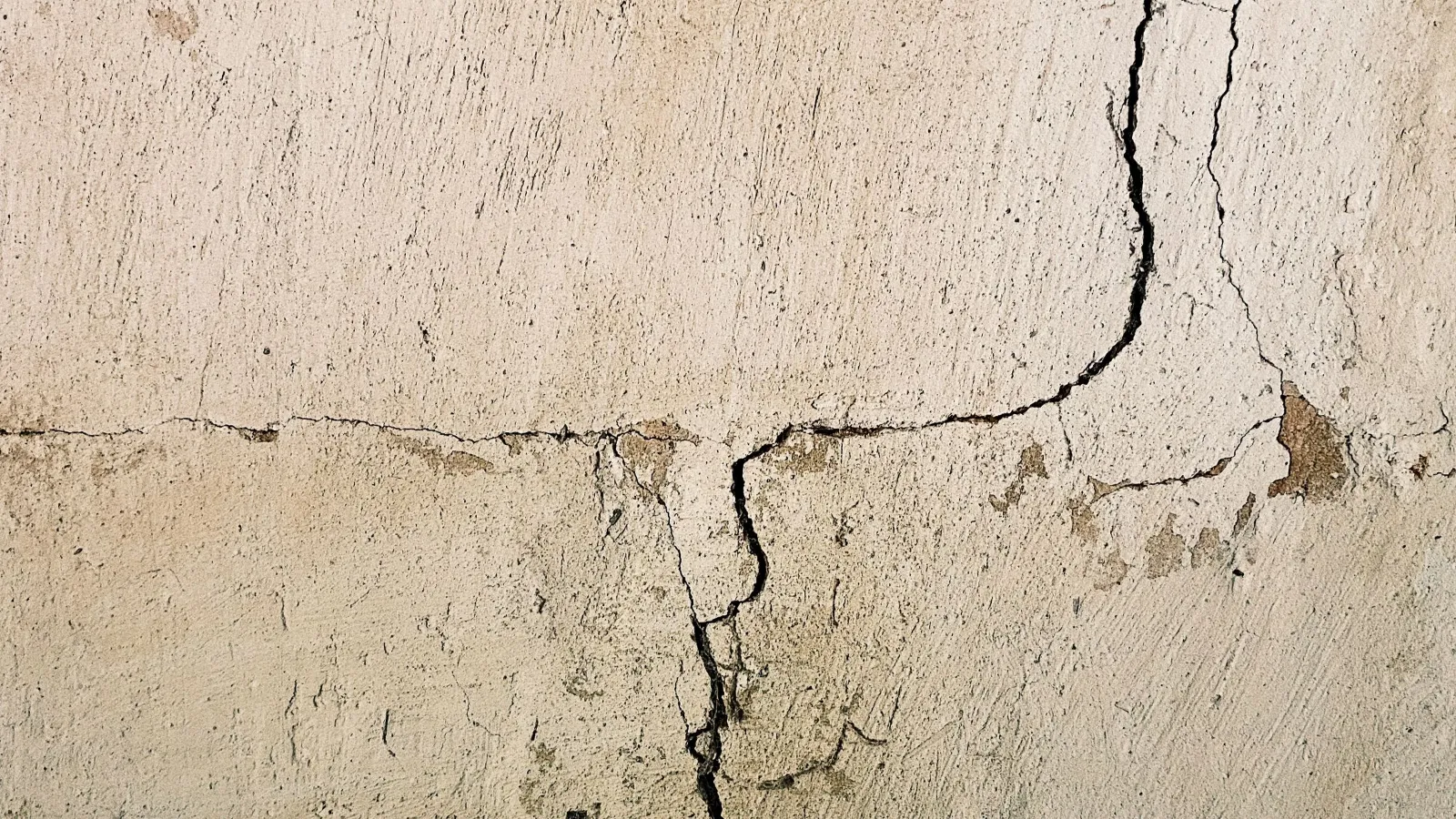
Many foundation cracks don't need any structural repair; an on-site assessment can confirm it. A vertical, fine, stable crack whose two edges stay in the same plane is most often drying shrinkage. What decides isn't the width: it's the pattern, the orientation, and whether or not it's still moving.
A crack in a foundation wall triggers two reactions, and both are wrong. Some owners call three contractors the same day and sign a piling quote before anyone has established whether the building is still settling. Others paint over it and never think about it again, until the day the basement door no longer closes.
This guide explains what an engineer really looks at when examining a crack, in what order, and why the most common answer is “monitor it for twelve months.”
Not all cracks are serious
Concrete cracks as it hardens. It's a material that shrinks as it loses its mixing water, and that shrinkage is restrained by the reinforcement, by friction at the footing and by the corners of openings. Wherever the tensile stress exceeds concrete's low tensile strength, it splits. This is normal: it happens in the first few years, then it stops.
That's why a typical shrinkage crack is vertical or slightly diagonal, fairly fine, often located near a basement window or a corner, and doesn't open any further from one year to the next. It can let water through, which is a real watertightness problem. It doesn't put the structure in question.
The two-edge test
Run your finger across the crack. If both sides are in the same plane, you have a crack. If one side sticks out further than the other, it's no longer just a crack: it's an out-of-plane offset, and it signals that two parts of the wall are no longer moving together. That one isn't something you monitor; it's something you have looked at.
The four patterns that decide
The diagnosis isn't made by width; it's made by pattern. Four shapes come up again and again, and they don't tell the same story.
- Benign Vertical, fine, stable Drying shrinkage. The concrete shrank as it hardened. If it hasn't moved in two years, it has generally stabilized. A watertightness issue, not a structural one.
- Monitor Diagonal from the corner of an opening Stress concentration at the corner of a window or door. Often benign, sometimes the first sign of settlement. How it changes over time settles the question.
- Have it looked at Stair-step in the masonry It follows the mortar joints, the path of least resistance. The signature of differential settlement: one part of the building is going down faster than the other.
- Have it looked at Horizontal at mid-height Lateral pressure on the foundation wall: saturated fill, frozen soil, surcharge at the surface. The wall is working in bending, which it wasn't designed for.
A fifth situation deserves to be named even though it isn't a crack: bulging, the swelling of a brick wall that bows outward. It reflects a loss of anchorage between the brick facing and the structure behind it. It's measured with a straightedge held vertically against the wall.
Why things move in Montreal
Montreal's subsoil explains a large share of our assignments. East of Mount Royal, the ground sits on the clays of the Champlain Sea, deposited about 10,000 years ago. These clays have a property that complicates life for residential foundations: they swell when they get wet and shrink when they dry out.
A dry summer lowers the water content of the clay under the footing. The clay loses volume. The building follows. The rainy fall brings the water back, the clay swells again, and the building partly rises. This seasonal movement is why some cracks open in August and close in May. It's a sign, and a good one: it tells you the soil is working and that the cause is water-related.
- 1.2 to 1.5 mfrost depth to respect below a footing
- ~1,000 Lwater a mature tree can draw from the soil on a summer day
- 15 to 25 mcommon anchoring depth for a pile in Montreal, depending on the soil
- 2 mmthreshold below which a stable vertical crack is generally not a concern
Three triggers come up often, and none of them is fixed by repairing the crack:
- a mature tree planted a few metres from the wall, drying out the clay on its side of the building and creating differential settlement;
- a downspout that empties at the base of the foundation, or a lot that slopes toward the house instead of away from it;
- a clogged weeping tile, often from iron ochre, which leaves the saturated fill to freeze in winter and push against the wall.
The frozen fill trap
A footing set properly below the frost depth doesn't protect the wall above it. If the adjacent fill is saturated and freezes, it expands and pushes sideways. That's the mechanism behind most of the horizontal cracks we see in Montreal basements, and it's almost always secondary to a drainage problem.
Knowing if your crack is still moving
This is the question that drives all the others. A stabilized crack gets sealed. An active crack gets diagnosed before anyone touches it. And the only honest way to decide is to measure twice, months apart.
- Draw a pencil line perpendicular to the crack, at a specific spot you can find again.
- Measure the width at that exact spot. A ruler marked in millimetres is enough; a caliper is better.
- Write the measurement and the date directly on the concrete, next to the line.
- Take a photo with the ruler in the picture.
- Measure again after a full winter and a full summer. You need the whole cycle, not six months.
A crack that hasn't moved in twelve months has generally stabilized. We'd rather tell you that than offer you a visit you don't need.
When movement is suspected across the whole building, the measuring tool changes. We carry out a level survey: fixed points at the corners and at mid-span, read with an optical or laser level, then read again later. The absolute value isn't what counts: many Montreal houses haven't been level for forty years and are perfectly stable. It's the difference between two surveys that tells the story.
What we're looking for is the angular distortion between two neighbouring supports, meaning the slope created by differential settlement. Load-bearing masonry starts to crack well before the structure's bearing capacity is really in question. In other words, the wall complains early, and that's a stroke of luck.
Injection, piles, or nothing
The crack doesn't decide the treatment; its cause does. And in many Montreal files, the cause is neither the concrete nor the footing: it's water.
| Drainage and grading | Injection | Piling | |
|---|---|---|---|
| Treats | the cause | watertightness | the support |
| Carries the load | no | no | yes |
| Suitable if | water is feeding the movement | the crack has stabilized | the foundation is still settling |
| Scale of the work | the lightest | intermediate | the heaviest |
| Prior diagnosis | required | required | required |
What injection does and doesn't do
Injection fills the crack from the inside to block water. Polyurethane stays flexible and tolerates slight residual movement; epoxy is rigid and bonds the two edges structurally, which only makes sense on a crack that has permanently stopped moving. Neither one carries a load or corrects settlement.
Injecting a crack that's still active is paying for it to come back. A new crack sometimes appears, parallel to the first, less than a year after the work.
When piling is justified
Three conditions have to be verified together, not guessed at: the level survey shows movement that's still active after the drainage has been corrected, the footing rests on fill or a compressible layer, and the bearing level is above the frost depth or on soil with insufficient bearing capacity. When all three are met, the load is transferred deeper.
Even then, piling isn't always the answer. Rebuilding a section of footing, correcting fill, placing a new bearing locally at a lower level: these are lighter interventions, and we recommend them whenever they're enough.
The order, which matters as much as the choice
Fix the cause. Let a full season go by. Then seal. A solution proposed before you know whether the movement has ended risks treating the symptom rather than the cause.
What your insurance doesn't cover
Almost nothing, on this specific subject. Quebec home insurance policies generally exclude natural ground movement: subsidence, landslides, erosion, freeze-thaw cycles, the effects of drainage. The exclusion applies regardless of whether there's another cause. Wear and tear and gradual deterioration are excluded as well.
Sewer backup and infiltration through the ground fall under separate endorsements, which many owners think are included when they aren't. Check your policy before you need it, not after.
In an insurance file, the dividing line is almost always the same: sudden and accidental, or gradual. A pipe that bursts and saturates the fill overnight isn't the same thing as infiltration that has gone on for eight years. That's what the insurer's adjuster works on, and that's where an independent engineer's report can make a difference.
If you think you have a claim
Photograph everything, date it, don't repair anything and don't throw anything away. A piece of pipe you've kept is worth more than a description from memory. A valid claim can be lost if the work is done before anyone has documented the cause.
The effect on resale
What scares off a buyer isn't a crack. It's a crack whose origin nobody can explain. An undocumented problem is a problem with no ceiling: the buyer, their inspector and their notary all imagine the worst-case scenario, and the worst-case scenario gets negotiated at a high price.
An undocumented problem is a problem with no ceiling.
An engineer's report that identifies the cause, establishes whether the movement has ended and prices the work, if any, turns an unknown problem into a bounded one. It's a strong argument, for the seller and the buyer alike.
When to call an engineer
Not for every crack. Sometimes the right answer is to measure for a year before calling in an engineer. Here are the situations that really justify a visit:
- a horizontal crack in a foundation wall, whatever its width;
- a stair-step crack in the masonry, especially if it widens toward the top;
- an out-of-plane offset between the two edges;
- a wall that bulges;
- doors or windows that stick on only one side of the building;
- a crack that has measurably moved between two surveys a year apart;
- a real estate transaction in progress, with an inspection report that raises the question;
- a dispute, an insurance claim, or a requirement from the city, the syndicate or the lender.
FAQ
Is a 3 mm crack serious?
Not necessarily. Width alone tells you almost nothing. A 3 mm vertical crack that has been perfectly stable for twenty years is a watertightness problem. A 1 mm stair-step crack that opened this year is a movement problem. It's the pattern and how it changes that decide, not the millimetre.
Can I repair it myself?
A stable shrinkage crack can be sealed with a store-bought product, and it will hold. But only seal what you've first established as stable, with two measurements taken a full cycle apart. Plugging an active crack means hiding the only indicator you had.
My neighbour had piles installed. Should I do the same?
No, and it's a risky comparison. Two neighbouring houses can sit on different fill, have footings at different depths, and trees that only act on one side. Piling is decided on a level survey of your building, not the one next door.
How long before a crack becomes dangerous?
The question is poorly framed, and that's understandable: a crack doesn't become dangerous over time; it is or it isn't, depending on what's causing it. A stabilized shrinkage crack generally doesn't become structural. Active settlement, on the other hand, progresses as long as its cause isn't treated, and its pace depends on the season, the drainage and the trees nearby.
Do I need an engineer or a foundation contractor?
The engineer establishes the cause and signs a document that carries legal weight; the contractor does the work. It's better if the person who makes the diagnosis isn't the one selling the work. Have the diagnosis done by a professional who has nothing to install, then put the quotes in competition on that basis.
Concerned about a crack?
Send us a photo with a ruler in place and where it is in the building. We'll tell you whether it warrants a visit.
Describe Your SituationScope of this guide. This content is general in nature and doesn't replace an engineer's opinion on a specific building. A crack is diagnosed on site, in the context of the soil, the drainage and the building's history.
Sources and references: National Building Code of Canada, Part 9 (footing depth below the frost line) · CAA-Québec, “5 types of damage never covered by insurers” (exclusions related to ground movement) · Champlain Sea clay deposits, Geological Survey of Canada. Last updated: August 26, 2026.